

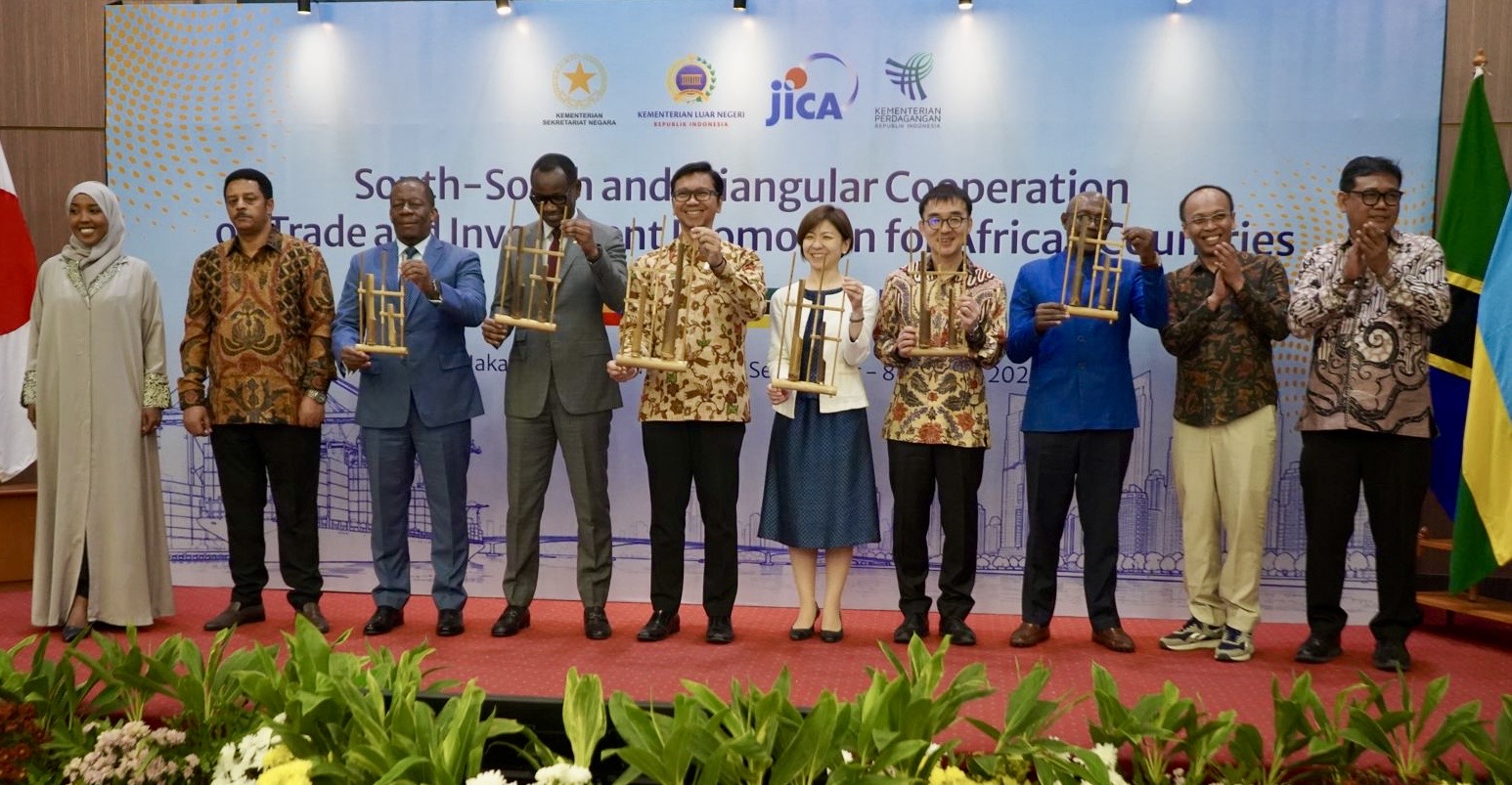
Jakarta, September 28, 2026 — The Government of Indonesia, through the Ministry of Trade and the Ministry of State Secretariat, together with the Government of Japan through the Japan International Cooperation Agency (JICA), and African partner countries today launched the South-South and Triangular Cooperation (SSTC) Training on Trade and Investment Promotion for African Countries 2026, which will be held in Jakarta from September 28 to October 7, 2026. The programme marks the second implementation of the Trade and Investment Promotion Training, following the inaugural programme held at the Center for Human Resources Development for Export and Trade Services (PPEJP), Jakarta, in 2025, with a different group of participating African countries. Building on the achievements and lessons learned from the first programme, the partners agreed to continue the initiative in 2026, with a particular focus on East African countries. This year’s programme brings together government officials and representatives from Ethiopia, Mozambique, Rwanda, Somalia, South Sudan, and Tanzania, alongside Indonesian government institutions, JICA, and other participating organizations. Their participation reflects a shared commitment to strengthening capacity and expanding cooperation in trade and investment promotion. The training is a tangible outcome of the Memorandum of Cooperation (MoC) signed between JICA and the Ministry of Foreign Affairs of Indonesia during the Indonesia-Africa Forum in September 2024. The partnership seeks to contribute to the 2030 Sustainable Development Agenda and Africa’s Agenda 2063 through triangular cooperation that combines the strengths and experiences of Indonesia and Japan. The continuation of the programme also reflects the broader objective of SSTC to build sustained partnerships, strengthen institutional relationships, and promote mutual learning, rather than serving as a one-time transfer of knowledge. This approach is rooted in the spirit of the 1955 Asian-African Conference in Bandung, which emphasized solidarity, equality, mutual respect, and shared prosperity. The 2026 training combines theoretical and practical learning, including discussions and engagement with Indonesian government institutions, experts, and other stakeholders. Key areas include trade facilitation, export development, trade negotiations, investment promotion, SME empowerment, regional economic cooperation, and Indonesia’s trade and investment ecosystem. Institutional visits and practical exposure will complement classroom sessions and provide participants with opportunities to explore Indonesia’s experience in ASEAN economic integration and SME internationalisation. The programme takes place amid growing economic integration in Africa, particularly through the African Continental Free Trade Area (AfCFTA). Indonesia shares its experience in ASEAN economic integration while emphasizing that regional integration requires not only agreements, but also strong institutions, effective trade facilitation, competitive businesses, supportive investment policies, and capable human resources. At the same time, Indonesia recognizes that each country has its own circumstances and development priorities, making mutual learning an essential element of cooperation. Indonesia also sees considerable potential to further strengthen economic relations with Africa. Indonesia’s trade with Africa reached USD 13.7 billion in 2023, while the Second Indonesia-Africa Forum in Bali in 2024 recorded business agreements worth USD 3.5 billion, compared with USD 568 million in 2018. In 2025, the Middle East and Africa region was among Indonesia’s fastest-growing export markets, with exports increasing by more than 11 percent year-on-year. Through the programme, Indonesia positions itself as an equal partner, knowledge provider, and facilitator of capacity development, sharing experience in trade promotion, export development, trade facilitation, digital trade, SME internationalisation, and trade human resource development. The programme also encourages participants to share their own experiences and perspectives, creating a two-way learning process among Indonesia, Japan, and African countries. JICA highlighted that the first training in 2025 generated valuable lessons and insights that were subsequently presented at the 9th Tokyo International Conference on African Development (TICAD-9) in August 2025. The continuation of the programme in 2026 reflects the partners’ commitment to further developing this cooperation, particularly in East Africa, a region with an important role in economic growth, regional integration, trade expansion, and investment opportunities. The programme also builds on JICA’s longstanding cooperation with PPEJP in developing trade-related human resources. JICA has supported PPEJP and its predecessor, the Indonesia Export Training Center (IETC), through Official Development Assistance grants and technical cooperation projects over several decades, contributing to PPEJP’s development as a key institution for export and trade human resource development in Indonesia. The training is designed to generate impact beyond the classroom. Participants are expected to develop action plans, strengthen institutional networks, continue knowledge exchange, and pursue follow-up technical cooperation after returning to their respective countries. The programme therefore seeks to translate capacity building into practical and measurable outcomes in trade and investment promotion. Through the second SSTC Training on Trade and Investment Promotion for African Countries, Indonesia, Japan, and African partners reaffirm their commitment to transforming knowledge exchange into lasting partnerships, strengthening the capacity of trade and investment institutions, and promoting more inclusive and sustainable economic cooperation among countries of the Global South.

